Amazon, Facebook, ICE, and the FBI Share a Private Intelligence Network Operated by Seattle Police
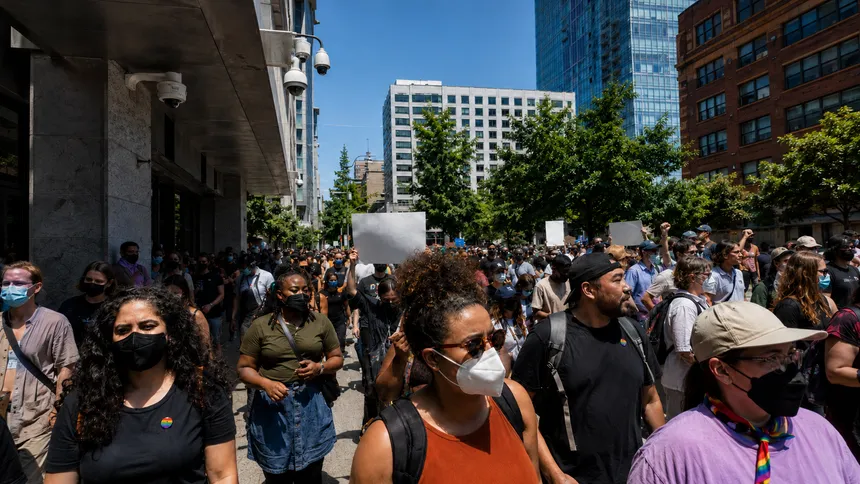
A new investigation reveals that Amazon, Facebook, ICE, and the FBI are members of Seattle Shield, a police-run network monitoring protests and sharing suspicious activity reports with hundreds of government and private-sector recipients.
Newcastle, WA – A new Prism investigation reveals that Seattle Shield, a secretive intelligence-sharing network operated by the Seattle Police Department (SPD), has counted Amazon, Facebook, Immigration and Customs Enforcement (ICE), and the FBI among its hundreds of members since at least 2020, with its bulletins in 2025 focused almost exclusively on protests across Seattle.
For LGBTQ+ people in the Seattle area, the findings carry a direct warning. Under a National Security Presidential Memorandum signed by President Trump in fall 2025, protected protest speech can now be treated as an indicator of domestic terrorist activity. The information Seattle Shield collects and distributes flows directly into a federal surveillance apparatus that includes ICE.
What Seattle Shield Is
Seattle Shield describes its mission as creating "a collaborative and information-sharing environment between the Seattle Police Department and public/private partners in the Seattle area." Member organizations are asked to assist police efforts "to identify, deter, defeat or mitigate potential acts of terrorism by reporting suspicious activity in a timely manner."
The network has operated since 2009 and was modeled on NYPD Shield, itself created after September 11, 2001. The concept spread to police departments across the country and the world through the Global Shield Network (GSN), a nonprofit umbrella organization. In October 2025, the GSN hosted its seventh annual global conference in Seattle, at the Sheraton Grand Hotel, co-hosted by SPD.
Through public records requests, Prism obtained the full Seattle Shield membership list as of 2020. That list runs to hundreds of individuals across multiple sectors:
- Law enforcement: FBI agents, a Department of Homeland Security analyst, Washington State Fusion Center intelligence analysts, and officers from jurisdictions as far away as Nassau County, New York, and the Hennepin County Sheriff's Office in Minnesota
- Federal immigration enforcement: ICE analysts and agents
- Private technology companies: Amazon and Facebook security analysts
- Private security and real estate management companies
- Nonprofits and civic organizations, including Seattle Theatre Group, which operates several live performance venues in the city
The SPD did not respond to Prism's detailed requests for comment. Amazon, Facebook, and each of their named analysts did not respond either.
Protests as the Primary Subject
A Prism review of dozens of Seattle Shield bulletins sent between 2020 and 2025 found a clear pattern: by 2025, the reports were almost exclusively about protests and potential traffic disruptions caused by protests.
A June 2025 bulletin sent over the network's mailing list stated plainly: "Immigration is currently a contentious topic around the United States. As you all have probably seen, there are many demonstrations taking place around the country to include Seattle. There has been a daily protest at the Federal Building this week where people are expressing their unhappiness with the federal government." Following those protests, SPD asked Seattle Shield members to look around their properties for items that could be used as "projectiles" during future demonstrations.
An October 2025 bulletin warned about local events tied to the anniversary of the Hamas attack on Israel, listing attacks on Jewish targets in other U.S. cities without noting widespread anti-Muslim and anti-Palestinian violence during the same period. It advised that "homegrown violent extremists, racially or ethnically motivated violent extremists, and grievance-driven malicious actors may use this anniversary to conduct their own attacks at any relevant target locations."
During the 2020 Black Lives Matter protests, Shield members received regular SPD updates. In one, the department asked members to "review their internal security video systems retention policies to ensure valuable evidence of criminal activities are retained/saved. We are requesting that all sites retain any video from May 29th 2020 through a date (TBD)."
The Trump Memorandum Raises the Stakes
Seattle Shield was already a civil liberties concern before 2025. Under the current federal administration, the risk is higher.
The Trump National Security Presidential Memorandum signed in fall 2025 identifies protected protest speech and constitutionally protected expression as potential "indicia" of terrorist threat. Seattle Shield feeds its reports into the Washington State Fusion Center, which itself collaborates with ICE.
Phil Mocek, a longtime Seattle privacy activist who has tracked the network since 2012, told Prism that the memorandum turns a longstanding concern into an immediate one.
"Somebody could show up to protest ICE, and then that information gets reported out to Seattle Shield and suddenly they could be on a terrorist watch list? That is not OK." Phil Mocek, privacy activist
Terry Albury, a former FBI agent who was later imprisoned after leaking documents about the FBI's use of law enforcement against vulnerable communities, described the network in starker terms.
"What did Hoover say? 'I want everyone to believe that there is an FBI agent hiding behind every mailbox.' That's what this list is doing. It's creating the panopticon." Terry Albury, former FBI agent
For LGBTQ+ people who attend immigration protests, trans rights vigils, or demonstrations of any kind in Seattle, the architecture Albury describes is not theoretical. It is operational, and it is connected to federal immigration enforcement.
No Demonstrated Public Benefit
The SPD has never publicly credited Seattle Shield with a terrorism arrest. Prism's review of the SPD crime blotter found no public mention of the network.
The FBI Seattle did not answer questions about whether Shield reports had ever led to an arrest. Its public affairs officer issued a generic statement about the FBI's partnerships being "critical to our mission."
The ACLU of Washington, one of the state's most prominent civil liberties organizations, told Prism it had not been following or looking into the network. That absence of scrutiny is part of the story: Seattle Shield has operated largely off the public radar for 17 years.
Mocek described the accountability gap directly: "This is something that should be tracked, accounted for, and probably audited. Any sharing between any part of Seattle's municipal government and Immigration and Customs Enforcement is concerning and I think would be concerning to the majority of the public."
Private Companies as Structured Informants
Seattle Shield is not simply a communications channel. It is a mechanism that converts private companies and nonprofit organizations into structured informants, with formal membership, access to SPD commanders, and training offered through the federal Law Enforcement Training Center under DHS.
One suspicious activity report from March 2025 illustrates how this works in practice: a man was observed at Pike Place Market trying to access an electrical room while claiming to be a subcontractor. Photos and a description were distributed over the Shield network to hundreds of members. No police report was filed. No crime occurred. The man did not gain access to any sensitive area. The photos nonetheless circulated to military intelligence officers, federal agents, and private security firms across multiple states.
Alongside suspicious activity reports, Shield bulletins give members private access to SPD commanders, inside information about department staffing, advance notice of dignitary travel, and private briefings on the city's "Terrorism Outlook" for 2025: information the SPD does not release publicly.
Albury summarized the dynamic: Seattle Shield is "a larger pool of informants, but they're official informants because now they have an association and a connection, in the same way that an unofficial informant is used off the books."
Connection to Broader Seattle-Area Surveillance
This story does not stand alone. Seattle Shield is one layer in an expanding surveillance infrastructure across the Seattle area.
We have previously reported on Flock Safety automatic license plate readers and the risk that ALPR data has been accessed by federal agencies for immigration enforcement, including under a Flock camera at Coal Creek Parkway and Newcastle Way. The fusion center that Seattle Shield feeds into, the Washington State Fusion Center, also collaborates with ICE.
The SPD's Relational Policing Plan explicitly calls for "developing partnerships with local companies." Separately, off-duty SPD officers work under contract for a downtown business association, DBIA Services, with a mandate to "approach public safety through the lens of economic vitality." Contracts obtained by Prism state that those officers "must approach public safety through the lens of economic vitality." Jennifer Casillas, vice president of DBIA Services, was a Seattle Shield member as of 2020.
Seattle Shield sits at the intersection of these relationships: a program that formalizes corporate participation in law enforcement intelligence collection, circulates that intelligence to hundreds of federal and private recipients, and has done so for 17 years with almost no public scrutiny.
What This Means for Our Community
The implications for LGBTQ+ people in the Seattle area are layered.
Queer and trans immigrants who attend any protest or public demonstration may now have their presence documented in a system accessible to ICE. LGBTQ+ activists and organizers who attend rallies, vigils, or marches in Seattle should be aware that the venues hosting them and the businesses nearby may all be members of a network that reports "suspicious activity" to federal authorities.
The classification of protest as a potential terrorism indicator is not bureaucratic overreach isolated to one memo. It is an architecture, built over 17 years, with a membership list that reads like a roster of Seattle's largest employers connected directly to the agencies that enforce immigration law and conduct domestic counterterrorism investigations.
The Prism investigation is the most detailed public accounting of Seattle Shield to date. The ACLU of Washington has said it is now paying attention.
Sources
- Prism (Stellmacher, May 20, 2026): Amazon, Facebook, ICE, and the FBI have access to a private intelligence-sharing network operated by Seattle police
- An ICE Detention Was Logged Under a Newcastle Flock Camera This Morning
- Flock Safety, Surveillance, and the Risk to Newcastle's Most Vulnerable Residents
