An ICE Detention Was Logged Under a Newcastle Flock Camera This Morning. The City Still Has No Independent Audit.
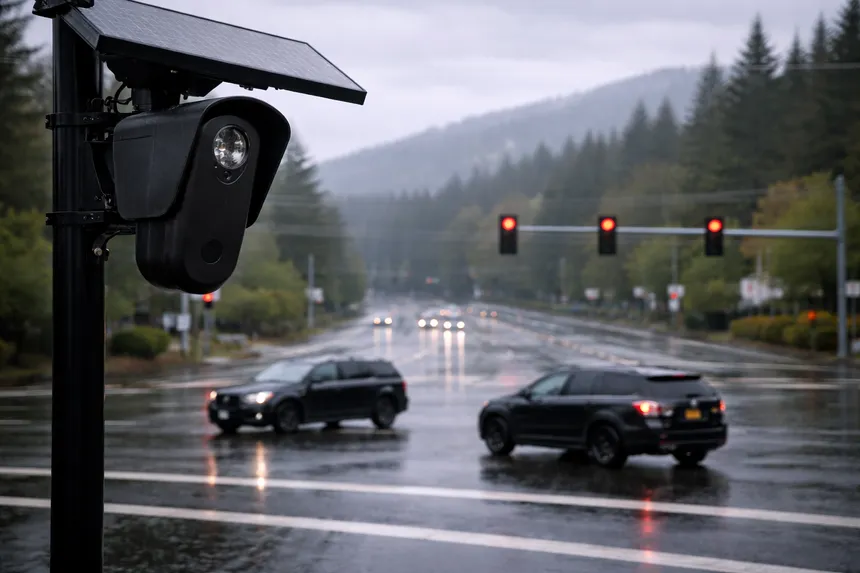
An ICE detention was logged this morning at Coal Creek Parkway and Newcastle Way, directly under a Newcastle Flock camera that has never been independently audited for federal access.
Editor's note, March 27, 2026: Three Newcastle City Council members have since responded to the questions raised in this article. Their replies include a significant correction: the city's Flock cameras were placed in hibernation on December 3, 2025, and were not active at the time of the March 24 detention. Read the full update.
Newcastle, WA – This morning, March 24, 2026, an ICE detention was logged at Coal Creek Parkway and Newcastle Way in Newcastle — directly under one of the city's Flock Safety ALPR cameras. Newcastle's cameras remain online and the city council has taken no independent action, even as SB 6002, Washington's new Driver Privacy Act, awaits the governor's signature and at least ten jurisdictions across the state have already shut their cameras down.
This article updates our November 2025 investigation into Flock Safety and surveillance in Washington and Newcastle. Readers unfamiliar with the background are encouraged to read that piece first.
An ICE Detention This Morning, Under a Newcastle Flock Camera
DFRoster, a community-driven ICE activity reporting platform, logged the stop at Coal Creek Parkway and Newcastle Way. According to the report, a Newcastle police officer operating under the King County Sheriff's Office contract was present in the area and drove past without intervening.
No independent news coverage of the incident was available at time of publication, which is consistent with how quickly street-level immigration enforcement actions occur. That is one reason tools like DFRoster, ICEBlock, and ICE Tea Tools emerged in 2025: individual ICE encounters often never become formal local news stories, even when they happen in heavily surveilled public space.
King County recorded 1,030 ICE arrests in 2025, the most of any Washington county, representing a 300-plus percent increase from January to December. Today's detention places Newcastle directly inside that countywide pattern.
Why a Flock-Covered Intersection Matters
As documented in our original report, federal agencies access local ALPR networks through three pathways: direct "front door" sharing, "back door" access through national lookup tools and undisclosed federal pilot programs, and "side door" searches in which local officers run queries on behalf of federal agencies. None of those pathways requires a warrant.
That is why the location of today's detention matters. A March 11, 2026 University of Washington Center for Human Rights data release documented how federal agents used license plate reader data to conduct what researchers called "non-custodial arrests": stops in which agents determined a person's "deportability" and made an arrest within as little as 10 minutes, without a warrant and without any individualized probable cause assessment of escape risk.
New national evidence shows how widespread that architecture has become. In San Francisco, SFPD allowed out-of-state agencies to make 1.6 million searches of its Flock database in violation of California law. At least 19 were ICE-related. In Syracuse, New York, the city council unanimously revoked Flock's permission to operate after discovering its data had been searched 4.4 million times by agencies nationwide. In Johnson County, Texas, a sheriff's deputy used Flock to search 83,345 cameras across 6,809 networks to track a woman suspected of self-administering an abortion.
The officer's reported inaction is consistent with KCSO's published policy under the Keep Washington Working Act: deputies do not participate in federal immigration enforcement and respond only to events that jeopardize public safety. But that policy does not answer the most important questions raised by today's detention. It does not say whether KCSO audits Newcastle's camera access logs for federal use, whether federal agencies have ever searched Newcastle data in connection with immigration enforcement, or whether the camera at that intersection logged the stop.
What SB 6002 Would Change
The most significant statewide development since our original report is legislative. SB 6002, the Driver Privacy Act, was co-sponsored by Sen. Yasmin Trudeau (D-Tacoma) and Sen. Jeff Holy (R-Spokane), passed the Senate 40-9 on February 4, 2026, passed the House 84-10 on March 5, and was delivered to Governor Bob Ferguson on March 12.
If signed, the bill would impose new obligations on Newcastle, KCSO, and every Flock-operating agency in Washington. Its key provisions include:
- A 21-day data retention limit, the second-shortest in the country
- An explicit ban on using ALPR data for immigration enforcement
- Restrictions on data sharing to in-state agencies only
- A public records exemption for ALPR data
- Mandatory two-year audit trails
- An emergency clause making the law effective immediately upon signing
Those changes matter because today's detention occurred before any independent local review of federal access to Newcastle's camera network. If signed, SB 6002 would not undo that, but it would create a clearer legal standard against which Newcastle's continued operation of Flock cameras could be judged.
The bill has also drawn criticism. The ACLU of Washington said it "does not go far enough," objecting to the 21-day retention window after earlier proposals were shorter. People Power WA and Seattle Indivisible opposed the final version on the grounds that it still leaves immigrant communities vulnerable. Civil liberties groups have also warned that vendor access and architectural workarounds remain unresolved.
Why Other Cities Have Shut Their Cameras Down
When our original report was published in November 2025, Redmond, Skamania County, Sedro-Woolley, and Stanwood had already suspended or shut off cameras after the UWCHR findings and the first Washington court ruling holding that Flock data constituted public records. Since then, the list has grown.
Olympia deactivated all 15 of its cameras on December 3, 2025, citing sanctuary-city concerns and the risks of federal data access. Lynnwood voted unanimously to terminate its contract on February 22, 2026 after discovering out-of-state agencies had searched its data with the stated reason "ICE." Everett shut down its system on February 25, 2026 after a Snohomish County Superior Court ruling that Flock footage constitutes a public record threatened to force mass disclosure of images. Edmonds paused its cameras, and Mountlake Terrace terminated its contract before installation.
The courts are still split. A Pierce County Superior Court judge later ruled the opposite way, meaning Washington now has conflicting superior court decisions on one of the central legal questions surrounding ALPR surveillance. SB 6002's public-records exemption may settle that question first, but multiple cities have already decided the risk is too high.
Some jurisdictions chose to narrow rather than end their systems. Renton, Auburn, Mukilteo, and Lakewood disabled National Lookup or restricted out-of-state access after the UW report. Mill Creek progressively narrowed sharing from Washington-only agencies to Snohomish County only.
Newcastle has taken neither path. No city council resolution, ordinance, or agenda item addressing Flock Safety, ALPR policy, or immigration enforcement appears in public records.
Newcastle Is Becoming an Outlier in King County
Newcastle operates Flock cameras through KCSO with a stated prohibition on immigration enforcement use. That prohibition appears on Flock's transparency portal. It does not appear in any Newcastle City Council ordinance, resolution, or published city policy.
The only immigration-related document on Newcastle's city website is a KCSO Statement on Immigration Enforcement, dated February 4, 2026: a county-level document, not a Newcastle policy. Newcastle is not a sanctuary city and has no standalone sanctuary protections beyond what Washington State and King County provide.
Meanwhile, King County has moved in the opposite direction. A March 3, 2026 moratorium passed on new detention facilities in unincorporated areas. Today, the King County Council is voting to prohibit ICE from staging operations on county property. Seattle is also voting today to extend CCTV privacy protections to ALPR data, a move that could set precedent across the region.
The UW report examined only 31 of the 80-plus Washington Flock-operating agencies. Newcastle was not among them, meaning no independent audit has ever been conducted of whether Newcastle's Flock data has been accessed by federal agencies through National Lookup, the CBP pilot program, or any other pathway, even though the UW documented that those vulnerabilities affected participating agencies broadly.
Newcastle's cameras captured 160,528 scans in a recent 30-day window, with 156 officer searches logged. For residents who use Coal Creek Parkway regularly, that can mean multiple daily captures. The city council has not met to discuss today's detention. No policy exists to require that it ever would.
And before concluding that the cameras should remain in place, it is worth noting that the research base does not support the broad crime-deterrence promises surveillance vendors make. Studies have found little evidence of meaningful violent-crime reduction, low rates of useful investigative hits, and substantial misuse, bias, and error. The strongest evidence for ALPR systems is narrow: stolen-vehicle recovery and some post-facto investigative assistance. That is a much smaller claim than the public-safety case typically used to justify routine, population-wide scanning.
What Newcastle Residents Should Ask Now
Our original report ended with five questions for Newcastle residents to bring to their council. After today's incident, those questions are no longer theoretical:
- Has Newcastle's Flock data been accessed by any federal agency, including through National Lookup or the CBP pilot program? KCSO and Newcastle should release an independent audit of all access logs.
- Will Newcastle adopt its own ordinance, separate from KCSO policy, explicitly prohibiting immigration enforcement use of city-contracted Flock data?
- What is Newcastle's compliance plan for SB 6002 once signed, including the 21-day retention limit and new audit obligations?
- Will Newcastle suspend cameras pending an independent review, as Redmond, Olympia, Lynnwood, and Everett have done?
- Will Newcastle hold a public forum so residents, particularly those from communities most at risk, can be heard?
The gap between Newcastle's stated Flock prohibitions and the absence of any enforceable local policy is both a governance question and a civil liberties concern. This morning, that gap was not abstract. It was a person detained at an intersection Newcastle cameras watch every day.
Sources
- University of Washington Center for Human Rights: Leaving the Door Wide Open (October 21, 2025)
- University of Washington Center for Human Rights: March 11, 2026 data release on non-custodial arrests and ALPR use in Pacific Northwest immigration enforcement
- 404 Media (Koebler, May 27, 2025): ICE Taps into Nationwide AI-Enabled Camera Network, Data Shows
- King5 News (Ingalls, November 9, 2025): Judge orders police to release surveillance camera data, raising privacy questions
- The Urbanist (Sundberg, June 19, 2025): License Plate Readers Proliferate in Washington, Bringing Concerns over ICE Overreach
- Washington State Legislature: SB 6002, Driver Privacy Act
- DFRoster: Coal Creek Pkwy SE sighting, March 24, 2026
- ACLU: How to Pump the Brakes on Your Police Department's Use of Flock's Mass Surveillance License Plate Readers (Marlow & Stanley, June 13, 2023)
- Senator Ron Wyden: Investigation into Flock Safety data-sharing practices and company claims
- Electronic Frontier Foundation: ALPR search log analysis, protest surveillance findings, and Flock Nova reporting
- Georgetown Law: American Dragnet report, ICE surveillance spending 2008-2025
- Forbes (Farivar): Flock Safety crime reduction claims investigation, San Marino, CA case study
