Transgender Day of Visibility 2026: Resilience Against the Tide
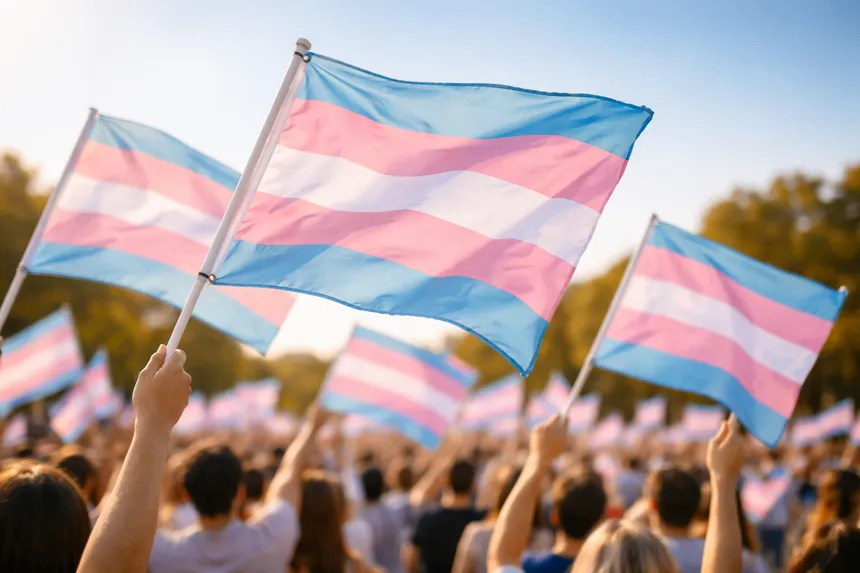
The most aggressive assault on trans rights in U.S. history, met by the strongest counter-movement of legal victories, electoral wins, and community resilience ever seen.
Newcastle, WA – As Transgender Day of Visibility approaches on March 31, 2026, the transgender community confronts a defining paradox: the most aggressive governmental assault on trans rights in modern American history, matched, point for point, by the most resilient counter-movement of legal victories, electoral wins, cultural breakthroughs, and community solidarity the country has ever seen. This is a moment of profound harm and profound strength, and it demands both clear eyes and honest celebration.
What Is Transgender Day of Visibility?
Rachel Crandall-Crocker, a licensed psychotherapist and executive director of Transgender Michigan, founded TDoV in 2009. Her motivation was direct: the only major trans observance at the time, Transgender Day of Remembrance, held every November 20, focused on mourning those killed by anti-trans violence. She wanted a day to "focus on the living." The first event was a small panel outside Detroit with a handful of U.S. cities participating.
March 31 was chosen for practical calendar reasons, spaced far enough from TDoR in November and Pride Month in June to avoid overlap. The date carries no prior historical significance.
By 2014, TDoV had gone international, with events in Ireland and Scotland. In 2021, President Biden became the first U.S. president to issue a TDoV proclamation. That same year, Chase Strangio and Raquel Willis launched the Trans Week of Visibility & Action (March 25–31), a lead-up action week that has since grown into its own organizing force.
The distinction between TDoV and TDoR is intentional and important: TDoV is celebratory and forward-looking; TDoR is a somber memorial. Both are necessary. This year, the line between them has never felt thinner, or more worth defending.
A Year of Legal Victories
The federal court system has functioned as a critical firewall against executive overreach. Since January 2025, federal judges have repeatedly blocked the Trump administration's anti-trans directives:
- In Shilling v. Trump, a nationwide preliminary injunction halted the transgender military ban on March 18, 2025.
- In PFLAG v. Trump, a Maryland federal court issued a nationwide injunction blocking healthcare funding cuts to gender-affirming care providers.
- In Orr v. Trump, courts required the State Department to allow trans plaintiffs to obtain passports reflecting their gender identity.
At the state level, Montana permanently struck down its gender-affirming care ban on May 13, 2025, a ruling grounded in Montana's constitutional right to privacy and therefore insulated from the U.S. Supreme Court's Skrmetti ruling (see below). The Montana Supreme Court had earlier unanimously upheld the preliminary injunction, making it the first state supreme court to do so.
In March 2026, a federal judge ordered Aetna to reconsider its blanket exclusion of facial feminization surgery, finding the policy was likely sex discrimination under Section 1557 of the Affordable Care Act.
On the legislative front, 18 states and the District of Columbia have now enacted shield law protections for gender-affirming healthcare, covering approximately 44% of the transgender population aged 13 and older (Movement Advancement Project). California signed seven pro-LGBTQ+ priority bills in October 2025, including health data privacy protections and streamlined name and gender marker changes. New York enacted Shield Law 2.0, among the strongest in the nation. Seattle passed a local shield ordinance in March 2025 creating a firewall preventing city employees from enforcing anti-trans laws from other jurisdictions, a model that community advocates have called on Newcastle and other King County cities to consider.
Electoral Wins Signal Shifting Politics
The 2025 election cycle delivered a clear message: anti-trans campaign strategies are losing political effectiveness even as anti-trans policy harm intensifies.
In Virginia, Democrat Abigail Spanberger won the governorship despite her opponent spending millions on anti-trans advertising. Exit polling found only 3% of voters named trans student issues as their top concern. In New York City, Zohran Mamdani was elected mayor, pledging $65 million for trans healthcare and designating NYC a sanctuary city for trans people. Similar patterns held in New Jersey and other contested races.
A record 171 out LGBTQ+ candidates ran in 2025, the highest ever in a non-federal election year. The LGBTQ+ Victory Fund endorsed 264 candidates across 37 states. Nonbinary representation in elected office has grown 3,900% since 2017.
The political calculus is shifting. The communities most targeted by anti-trans legislation are increasingly organized, funded, and winning.
The Federal Assault
Against those gains stands an unprecedented use of executive power.
On January 20, 2025, the Trump administration signed Executive Order 14168, mandating federal recognition of only two sexes defined as "immutable" and "determined at conception." The order banned gender self-identification on federal documents including passports, directed the Bureau of Prisons to house inmates by birth sex and halt gender-affirming care, rescinded Biden-era LGBTQ+ protections, and distributed "forbidden terms" lists to federal agencies banning words including "gender," "transgender," and "LGBT." HUD stopped enforcing protections against gender identity discrimination in federally funded shelters. By July 2025, a Lancet investigation found approximately half of all U.S. health datasets had been substantially altered to remove gender-related content.
Executive Order 14187, signed January 28, labeled gender-affirming care "chemical and surgical mutilation." The FBI publicly solicited tips about hospitals providing such care in June 2025. HHS proposed rules in October 2025 prohibiting Medicaid reimbursement for care to trans patients under 18. Several major children's hospitals, including Children's National in Washington, D.C., shut down pediatric gender programs before enforcement even began.
On June 18, 2025, the Supreme Court issued its ruling in U.S. v. Skrmetti. In a 6–3 decision, the majority upheld Tennessee's ban on puberty blockers and hormone therapy for trans minors, holding the law requires only rational basis review, the lowest constitutional standard. The ruling effectively insulated all 25 active state bans from federal Equal Protection challenges. Justice Sotomayor's dissent drew direct parallels to Loving v. Virginia.
The legislative picture compounds the judicial one. 867 to 1,022 anti-trans bills were introduced across 49 states in 2025, the most in U.S. history and the sixth consecutive record year. At least 51 were signed into law. 27 states now ban gender-affirming care for minors. 25 states restrict bathroom access for trans people. Iowa became the first state to remove gender identity as a protected class from its civil rights code. Utah became the first state to ban pride flags in government buildings and schools.
The international picture offers little comfort. The UK Supreme Court ruled unanimously in April 2025 that trans women with Gender Recognition Certificates are no longer legally recognized as women under the Equality Act. Hungary banned LGBTQ+ public assemblies. Russia designated the LGBTQ+ movement an "extremist organization." New Zealand announced a ban on puberty blockers for minors. The TGEU Trans Rights Index 2025 found that for the first time in 13 years, setbacks across Europe and Central Asia outweigh progress.
By the Numbers
The data behind the headlines:
- 2.8 million people aged 13+ identify as transgender in the U.S., 1.0% of that age group; 724,000 are youth aged 13–17 (3.3% of youth), Williams Institute, August 2025
- 27 trans people were killed in the U.S. between November 2024 and November 2025 (HRC); 281 globally (TGEU). 73.7% of U.S. victims since 2013 are Black trans women; 88% of global victims are Black or Brown
- 46% of trans and nonbinary youth seriously considered suicide in the past year (Trevor Project 2024)
- A landmark Nature Human Behaviour study found anti-trans state laws increase suicide attempts by up to 72% among trans and nonbinary youth
- Youth receiving gender-affirming care show 60% lower odds of depression and 73% lower odds of suicidality (JAMA Network Open)
- Access to mental health care among LGBTQ+ youth dropped from 80% to 60% in a single year; reports of being threatened with conversion therapy doubled from 11% to 22% (Trevor Project SPARK longitudinal study, October 2025)
- 56% of Americans support protecting trans people from discrimination, down from 64% in 2022 (Pew, February 2025), though 75% support general LGBTQ+ nondiscrimination protections (PRRI 2025) and 55% oppose laws restricting youth gender-affirming care, including 41% of Republicans
The People Carrying the Movement Forward
Sarah McBride was sworn in on January 3, 2025, as Delaware's at-large House Representative, the first transgender member of the U.S. Congress, winning with 57.8% of the vote. She has faced deliberate misgendering on the House floor and a targeted Capitol bathroom ban introduced by Rep. Nancy Mace. She has also spoken at retirement ceremonies for five trans service members discharged under the military ban. Her presence is both a milestone and a measure of how far the opposition will go.
Chase Strangio became the first openly transgender lawyer to argue before the U.S. Supreme Court when he presented oral arguments in Skrmetti on December 4, 2024. Though the case was lost 6–3, the moment was historic. Strangio also co-created the Trans Week of Visibility & Action with Raquel Willis and continues to lead ACLU litigation challenging anti-trans executive orders.
Alex Consani, at 21, became the first transgender woman to win Model of the Year at the British Fashion Council's Fashion Awards in December 2024. She was also among the first trans models to walk the Victoria's Secret Fashion Show and was named to Forbes 30 Under 30 and Time's inaugural Time 100 Creators list. In her acceptance speech, she honored the Black trans women who built the path she walks.
Karla Sofía Gascón became the first openly transgender actor nominated for an Academy Award (Best Actress) for Emilia Pérez, a film that received 13 Oscar nominations, a record for an international production. The moment carried genuine complexity: the film was also heavily criticized by trans critics and Mexican audiences for stereotypical portrayals, and Gascón's past offensive social media posts led to public distancing by co-stars and Netflix. Her nomination is a milestone that the community holds with nuance, not uncritical celebration.
Laverne Cox's sitcom Clean Slate premiered February 6, 2025 on Prime Video and was canceled after one season in April. Despite the cancellation, a 2026 analysis found Clean Slate accounted for a disproportionate share of all trans representation on television that year, a telling indicator of how thin that representation remains. Critics also documented that 2025 produced the lowest on-screen trans character count and highest number of anti-trans jokes of any year tracked.
Visibility as Liberation, and as Risk
No reflection on TDoV can be complete without grappling with a critique that has never left the conversation since the day was founded.
Miss Major Griffin-Gracy, a Black trans activist and survivor of the Stonewall uprising, said in 2019: "I don't really understand why we need a day of visibility, when for most of us, especially us Black girls, we are as visible as we need to be. Our visibility is getting us killed."
Her words land differently in 2026 than they did even then. The data bears her out: 73.7% of all trans people killed in the U.S. since 2013 have been Black trans women. Globally, 88% of trans murder victims are Black or Brown. Visibility has never been the problem for those communities, it has been the condition of their danger.
This tension sits at the heart of TDoV's mission: the day was created for communities whose existence is denied, who are made invisible in law and culture and medicine. But it is being observed in a moment when other communities are made targets precisely because they are visible, because they have flags, because they have representatives, because they show up.
Both things are true. Visibility is a tool of liberation for those who are erased. Visibility is a vector of targeting for those who are exposed. Transgender Day of Visibility does not resolve this tension. It insists on holding it. It says: we will be seen, and we will fight for the right of everyone in this community to be seen safely, which means fighting for the conditions that make safety possible. Shield laws. Healthcare access. Legal recognition. Electoral power. The long work.
As the trans flags rise on March 31 in Newcastle and in cities across the country, they rise in the full knowledge of what visibility costs and what it makes possible.
Sources
- PBS News: Transgender Day of Visibility history and founding
- NPR: TDoV background and growth milestones
- GLAAD: 2025 anti-LGBTQ+ incidents tracking
- PFLAG: TDoV resources and history
- Britannica: Transgender Day of Visibility
- Williams Institute, UCLA School of Law: How Many Adults and Youth Identify as Transgender in the United States? (August 2025)
- Movement Advancement Project: Shield law coverage data
- Trevor Project: 2024 National Survey on LGBTQ Youth Mental Health
- Trevor Project: SPARK Longitudinal Study (October 2025)
- Human Rights Campaign: Fatal Violence Against the Transgender and Gender-Expansive Community (2024–2025)
- TGEU (Transgender Europe): Trans Murder Monitoring 2025; Trans Rights Index 2025
- ACLU: Shilling v. Trump; PFLAG v. Trump; Orr v. Trump case updates
- Lambda Legal: "Proud & Free" mobilization coverage
- Nature Human Behaviour: Anti-trans laws and suicide attempt rates (September 2024)
- JAMA Network Open: Gender-affirming care and youth mental health outcomes (2022)
- Pew Research Center: American Views on Transgender Issues (February 2025)
- PRRI: 2025 American Values Survey
- 19th News / SurveyMonkey: Poll on gender-affirming care restrictions (April 2025)
- LGBTQ+ Victory Fund: 2025 candidate and election data
- British Fashion Council: Fashion Awards 2024, Model of the Year
- SSRN: Trans economic outcomes meta-analysis, 88 countries (September 2025)
- The Lancet: Federal health dataset alterations investigation (July 2025)
