From Campus Brand to High School Beachhead: How Turning Point USA Is Targeting Students – And What It Means For Issaquah
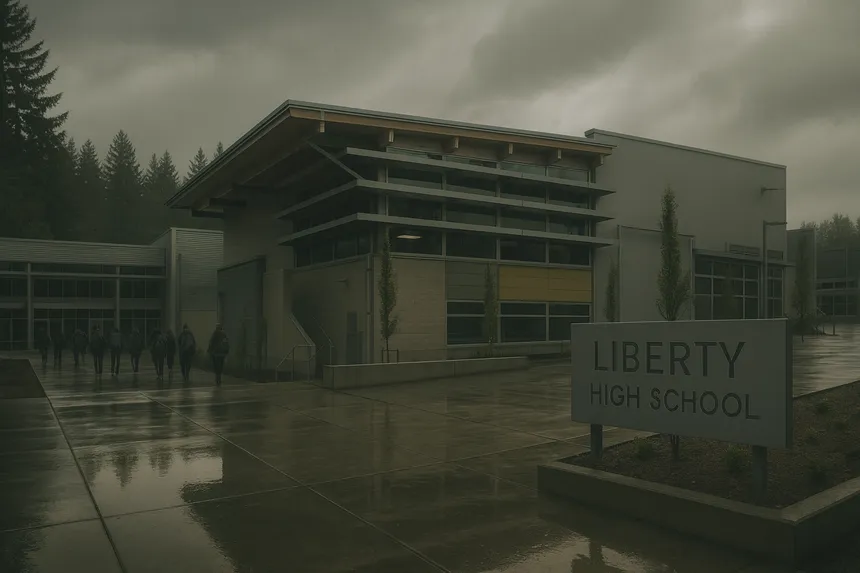
An investigative look at TPUSA's expansion into high schools and its arrival at Liberty High School in Issaquah.
Newcastle, WA – To most people, Turning Point USA (TPUSA) still looks like a familiar kind of campus club: a table with free stickers, a “free speech” stunt, or a controversial guest speaker whose presence triggers lively arguments. That image is not accidental. It is a carefully crafted brand designed to make TPUSA seem like one more participant in the so-called “marketplace of ideas,” a phrase that in mainstream civic language refers to open debate, but in modern far-right usage has become a coded rhetorical shield. Within that rhetorical frame, the “marketplace of ideas” is invoked not to foster genuine dialogue, but to justify platforming extreme views while dismissing criticism as censorship. This dog whistle is used to reframe harm as mere disagreement and to paint any pushback as intolerance.
Behind this familiar veneer sits something radically different: a highly structured, heavily financed national political machine now reaching deep into high schools as well as colleges, and increasingly into churches, pastor networks, and K-12 curriculum activism. TPUSA is closely aligned with the MAGA movement, deeply associated with Christian nationalist politics, and funded by some of the wealthiest conservative families in the United States. Its arrival at Liberty High School (LHS) in the Issaquah School District is not a neutral expression of “diverse viewpoints.” It is a node in a much larger, coordinated national strategy.
Understanding that strategy, what it is, how it works, and what it has already produced, is a basic requirement for any community deciding how to protect students, uphold academic freedom, and maintain a safe learning environment.
What Turning Point USA says it is, and what the record actually shows
Turning Point USA describes itself as a “student movement for freedom,” focusing on free markets, limited government, and economic civics. Founded in 2012 by Charlie Kirk and Tea Party activist Bill Montgomery, TPUSA went from a shoestring operation to a multimillion-dollar empire within a few years. By the early 2020s, it reported tens of millions in annual revenue and claimed chapters on thousands of campuses.
On paper, TPUSA chapters are “non-partisan” activism groups. But the organization’s long public record, internal materials, and extensive investigative journalism tell a sharply different story.
TPUSA is widely described by researchers, journalists, and watchdog groups as:
- A central youth arm of the pro-Trump political movement
- A generator of culture-war content designed for viral outrage
- An organization that promotes misinformation about elections, COVID-19, and public health
- A political operation that intervenes covertly in student governments
- A platform for hard-right rhetoric about race, gender, and sexuality
TPUSA’s most infamous initiatives illustrate the pattern.
The “Professor Watchlist,” launched in 2016, and the “School Board Watchlist,” launched in 2021, publish names, photos, and allegations against educators accused of spreading “leftist propaganda.” These watchlists have been condemned by academic freedom organizations, civil-liberties advocates, and even some conservatives for fostering targeted harassment, threats, and censorship. Studies describe them as modern-day blacklists masquerading as transparency tools.
This is not what a neutral “marketplace of ideas” looks like. It is a surveillance-driven intimidation strategy.
Charlie Kirk and the ideological engine behind the movement
To understand TPUSA’s trajectory, one must understand its founder. Charlie Kirk’s public positions have undergone a dramatic transformation. Early in his career he defended traditional church-state separation. By the 2020s he had become one of the most vocal champions of Christian nationalism, claiming:
- The separation of church and state is a “fabrication”
- America cannot function unless it has a majority Christian population
- Christianity must dominate seven spheres of society, including government and education
This is the ideology behind Turning Point Faith, TPUSA’s national church-mobilizing project. With a multi-million-dollar budget, it recruits pastors and congregations to support Christian nationalist politics, framing this involvement as “restoring America to its biblical foundations.”
Alongside this religious project, Kirk’s rhetoric on race, civil rights, and LGBTQ+ issues grew increasingly extreme. He attacked the Civil Rights Act as a “huge mistake,” described Martin Luther King Jr. as “awful,” and repeated demographic “replacement” narratives usually associated with white nationalist discourse. On LGBTQ+ issues, he called queer activists the “alphabet mafia,” described transgender identity as “a throbbing middle finger to God,” and demanded criminal prosecution of doctors who provide gender-affirming care.
None of this is hidden. It is part of TPUSA’s own public programming, echoed across national conferences and student events. When a TPUSA chapter arrives in a school district, this is the ideology that enters the building, even if local student members do not initially present themselves as aligned with these beliefs.
From campus theatrics to coordinated K-12 organizing
TPUSA’s public presence is built on a very specific form of activism: provocative stunts engineered for social media. Internal handbooks describe these events in detail, complete with scripts, budgets, and prop lists. Examples include:
- Halloween “graveyards” representing the “victims of socialism”
- Side-by-side “capitalist vs. socialist Thanksgiving tables”
- Giant “Free Speech Balls” designed to provoke confrontations
- Displays crafted to spark outrage more than dialogue
These spectacles are not designed to educate. They are designed to trigger reactions, create content, and reinforce a narrative of conservative victimhood.
Less visible, but more consequential, is TPUSA’s documented covert involvement in student government elections. Investigations have revealed that TPUSA has funded student campaigns, supplied professional staff, and instructed candidates to hide this assistance. These operations, described internally as “rather undercover” and “on the DL,” have triggered scandals at multiple universities where TPUSA-backed candidates were caught violating campaign rules.
What began as a college-level strategy has now expanded aggressively into high schools. State officials sympathetic to Christian nationalist politics have encouraged TPUSA’s K-12 growth. Oklahoma State Superintendent Ryan Walters publicly vowed to establish TPUSA chapters in every high school in his state. TPUSA now offers high school-specific materials, branding kits, adult field representatives, and even alternative schooling options through Turning Point Academy.
The expansion into K-12 is not incidental. Public schools are now seen as key battlegrounds for shaping future voters, weakening teachers unions, and replacing inclusive curricula with Christian nationalist frameworks.
Liberty High School: a local example of a national campaign
Within this national context, the quiet approval of a TPUSA club at Liberty High School in the Issaquah School District is not just another student club. It is a strategic beachhead.
Parents learned of the club only after the Liberty Booster Club posted about it on Instagram. Community reactions ranged from concern to alarm:
- Fear that TPUSA’s presence would “empower students to express hateful opinions.”
- Worries about TPUSA bringing Christian nationalist extremism into the school.
- References to the group as a “youth indoctrination program” and “high school Nazis.”
- Concerns about rising antisemitic comments at Liberty following the club’s approval.
- Shock that any faculty member would sponsor a TPUSA chapter.
Some community members emphasized that conservative students have the right to organize. Others argued that TPUSA is not an ordinary conservative club but a national group with a documented history of harassment, disinformation, and extremist rhetoric.
The question here is not whether students may form political clubs. It is whether public schools must accept political franchises backed by billionaire donors, professional staff, and national intimidation campaigns as though they were student-run organizations.
How Issaquah’s rules can be exploited by national advocacy groups
The Issaquah School District has clear rules governing student clubs. At Issaquah High School, official clubs must:
- Have a staff advisor
- Submit a constitution
- Elect student officers
- Hold regular meetings
- Undergo approval by the ASB Executive Board, Activities Coordinator, and Student Senate
- Adhere to financial disclosure and fundraising rules
Interest Groups have fewer requirements but still need an advisor, active student participation, and formal approval.
These rules are designed to ensure clubs are genuinely student-driven.
National groups like TPUSA are explicitly structured to bypass these protections.
TPUSA provides:
- Pre-written constitutions
- Professionally designed branding and logos
- Paid field staff to guide students through the approval process
- Activism grants and funding pipelines
- A national narrative that frames any rejection as censorship
To a busy Activities Coordinator or administrator, a TPUSA club may appear compliant on paper even when it is not student-led in practice. The risk is that district policies intended to support student agency are repurposed to legitimize outside ideological operations.
A broader ecosystem of pressure: the Freedom Foundation and parallel attacks on public education
TPUSA’s presence in schools exists alongside a larger network of conservative advocacy groups targeting public education. In Washington state, one of the most significant is the Freedom Foundation, a well-financed organization dedicated to weakening public-sector unions, especially teachers unions.
The Freedom Foundation has:
- Used mass spam campaigns, junk mail, and door-to-door canvassing to pressure teachers to drop union membership
- Requested personal data from the state (including names and birthdates), raising privacy concerns
- Purchased ads attacking individual educators
- Launched lawsuits aimed at undermining collective bargaining
- Promoted a new “Teacher Freedom Alliance” designed to attract educators to “pro-America” alternatives to unions
Teachers and unions describe these tactics as harassment and ideological intimidation.
The combined effect is a “pincer movement”:
- External pressure from anti-union groups like the Freedom Foundation attempts to weaken educator protections and public trust in schools.
- Internal pressure from youth-oriented groups like TPUSA attempts to reshape student culture, target educators, and build political influence within schools.
This is not accidental. The shared ideological ecosystem behind these groups views public education as a threat to its political agenda and aims to replace it with privatized or religiously aligned alternatives.
What this means for Issaquah students, staff, and families
For students
A TPUSA chapter can significantly affect school climate, especially for LGBTQ+, Jewish, immigrant, and BIPOC students. When TPUSA’s national leaders disparage trans people, attack civil rights, and repeat white-grievance narratives, marginalized students reasonably fear that local chapters may normalize or amplify hostility.
For educators
The combination of local TPUSA activism and national watchlists creates a chilling effect. Teachers who teach inclusive curricula or discuss race, gender, or U.S. history risk being singled out. The presence of a TPUSA club inside a building where teachers know they could be watchlisted undermines academic freedom.
For administrators
Schools must balance viewpoint neutrality with their obligation to ensure student safety. Accepting TPUSA as “just another club” ignores its documented track record of harassment, disinformation, and targeted intimidation. Nothing in federal law requires schools to accept clubs controlled by outside organizations or funded by national advocacy networks.
Transparency, oversight, and firm boundaries are essential.
Issaquah as a case study in a national pattern
The Liberty High School TPUSA chapter is not an isolated incident. It is part of a national strategy:
- K-12 TPUSA chapters spreading rapidly
- Christian nationalist rhetoric being mainstreamed through youth events
- Attacks on teacher unions coordinated by groups like the Freedom Foundation
- Public schools being reframed as ideological battlegrounds
The question for Issaquah families is not “Should conservative students have a voice?” They should. The question is whether the school district understands the difference between organic student clubs and national political operations using schools as recruitment and amplification platforms.
TPUSA is the latter.
Conclusion: Vigilance, not panic
Public schools cannot and should not shield students from every political idea. But they can draw clear lines around transparency, external influence, student safety, and the integrity of learning environments.
TPUSA’s push into Liberty High School, and into high schools across the country, is part of a national strategy backed by significant money, Christian nationalist ideology, coordinated intimidation tactics, and a track record of spreading harmful disinformation. Recognizing this reality is not alarmism. It is responsible stewardship.
For Issaquah students and families who care about inclusive, evidence-based education, and for educators who deserve safe working conditions, the task is straightforward:
- Insist on honesty about what outside organizations really are
- Protect students most likely to be harmed
- Maintain strict oversight of club formation and outside involvement
- Treat public schools as shared institutions belonging to the whole community
Sources
- Glatter, H. (2017, May 12). The Best education writing the week of May 6. The Atlantic. https://www.theatlantic.com/education/archive/2017/05/student-government-politics-and-identity-politics-this-weeks-top-7-education-stories/526350/
- Inside a stealth plan for political influence. (2017, May 7). The Chronicle of Higher Education. Retrieved November 20, 2025, from https://www.chronicle.com/article/inside-a-stealth-plan-for-political-influence/
- McCammon, S., & Rascoe, A. (2025, September 21). How religion shaped Charlie Kirk’s politics and his legacy. VPM. Retrieved November 20, 2025, from https://www.vpm.org/npr-news/npr-news/2025-09-21/how-religion-shaped-charlie-kirks-politics-and-his-legacy
- Slodysko, B. (2023, October 10). How Trump’s movement helped Charlie Kirk become a millionaire | AP News. AP News. https://apnews.com/article/election-2024-trump-turning-point-maga-d08a98e439fa4e902cb756d7e35153db
- Spies, M., & Pearson, J. (2023, December 20). At this Trump-Favored charity, financial reporting is questionable and insiders are cashing in. ProPublica. https://www.propublica.org/article/at-this-trump-favored-charity-financial-reporting-is-questionable-and-insiders-are-cashing-in
- Teachers are getting targeted anti-union emails from conservative groups. (2018, August 7). PBS News. https://www.pbs.org/newshour/education/teachers-are-getting-targeted-anti-union-emails-from-conservative-groups
- Wikipedia contributors. (2025, November 19). Charlie Kirk. Wikipedia. https://en.wikipedia.org/wiki/Charlie_Kirk
